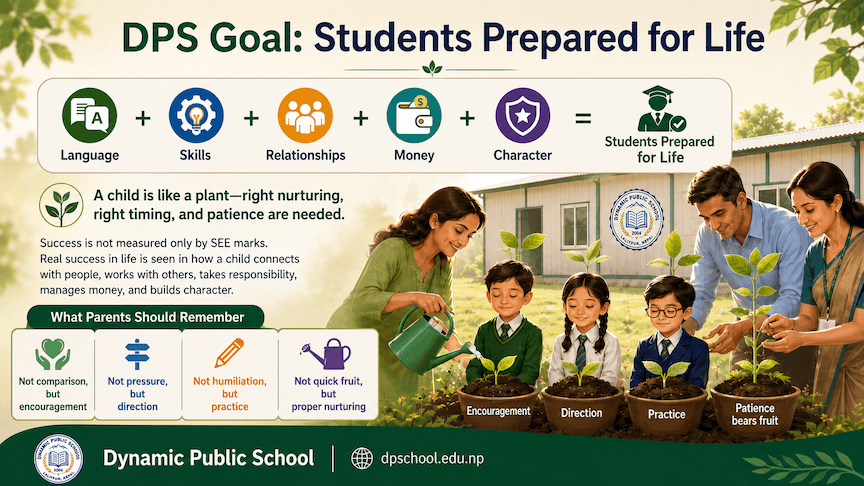
Dynamic Public School's philosophy of education is not limited to just passing exams. Our goal is to prepare students for life. We want every student who passes Grade 10 from DPS to leave strong in language, skills, relationships, money, and character.
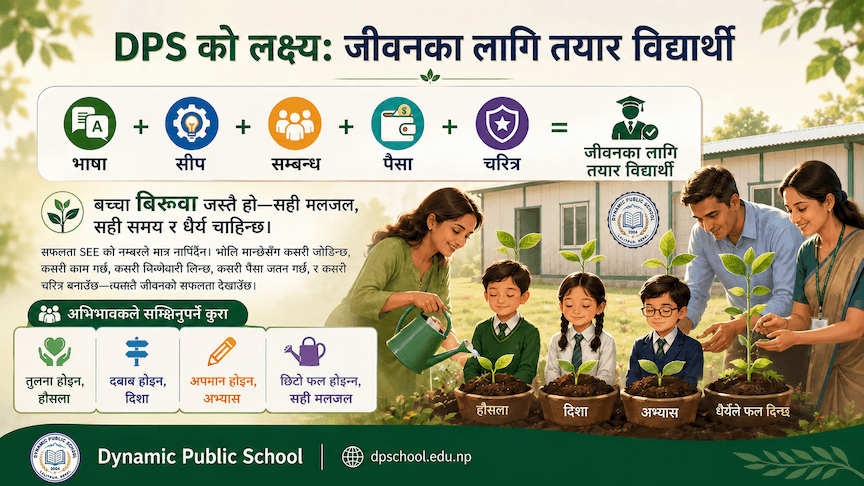
Our core formula is:
A child is like a plant
We think of children as plants. After planting a sapling, you cannot demand fruit immediately. It needs water, fertilizer, sunlight, protection, pruning, and patience — each at the right time. In the same way, a child needs love, discipline, practice, a good environment, and time.
Sometimes parents wish their child would climb classes as fast as possible, score high marks quickly, and appear ahead of other children. This wish is natural. But a child's development is not only about moving up quickly or scoring high marks. How mature the child is becoming inside, how strong their language is becoming, how good their behaviour is, and how much responsibility they are taking — these matter even more.
If you pull a plant to make it grow faster, it doesn't grow faster; instead its roots weaken. In the same way, excessive pressure, comparison, and humiliation do not make a child strong. A child needs the right direction, encouragement, practice, and patience.
Success is not measured by SEE marks alone
SEE results matter, but success in life is not measured by SEE marks alone. How a student moves forward in life tomorrow depends on many things.
How does the student connect with people? How do they cooperate with others? Can they take responsibility or not? Can they express themselves clearly in both Nepali and English? Do they know how to save money and use it wisely? What are their character, humility, honesty, and hard work like? These things reveal real success in life.
1. Language: Strong in both Nepali and English
DPS's goal is to make students strong in both Nepali and English. We want students to be able to read, write, speak, understand, and type well in both languages.
English is necessary to connect with today's world. Students should not be afraid to speak English. They should be able to express their ideas with confidence.
But Nepali is equally important. To study, work, join government or public service, connect with society, and understand legal and administrative language in Nepal, Nepali must be strong. Some students who study in English medium face problems in college or in government systems when their Nepali is weak. Our aim is that DPS students do not fall behind later because of weak Nepali.
So our language goal is clear: let the student know Nepali, let the student know English, and let them read, write, speak, and type in both languages.
2. Skills: Practical ability alongside studies
Today's education must not be limited to books alone. A student should be able not only to write by hand but also to type in both Nepali and English on a computer. They should know how to use technology. They should be able to apply what they learn in practice.
Skill is not only about operating a computer. Time management, problem solving, the ability to present, the habit of working in a group, neat writing, clear speaking, regular practice, and responsibility are all part of skill.
We want DPS students not just to memorize answers, but to become people who can think, do, and apply what they learn to life.
3. Relationships: Students who can connect with people
In tomorrow's world, marks alone do not get you a job. Society, institutions, and workplaces look for people who are humble, helpful, disciplined, responsible, and able to work well with others.
A student should learn to respect teachers and to build good relationships with friends. At home they should learn to listen to parents, to love younger siblings, to work in groups, and to cooperate even with people who hold different views.
Our goal is that DPS students, wherever they go, become people who improve their environment rather than spoil it.
4. Money: Students who understand the value of money
In life, earning money is hard and spending it is easy. Students should understand the value of money from an early age. Where money comes from, how to look after it, how to save, and how to spend it in the right place — these too are life education.
Our aim is not to make students greedy, but to make them responsible. A student who knows the value of money, can look after it, cuts unnecessary spending, and thinks about the future can go far in life.
5. Character: The foundation of life
Language, skills, relationships, and money are all important, but the foundation of them all is character. Knowledge without character can bring arrogance. Skill without character can be misused. Money without character can be wasted. Relationships without character can turn into selfishness.
That is why at DPS we want to make students honest, humble, hardworking, disciplined, responsible, and respectful of others.
Character is not doing good work only when someone is watching; it is the habit of doing the right thing even when no one is watching.
What parents should remember
Both home and school play an important role in a child's development. Teachers teach at school, but the home environment shapes a child's habits. So parents should pay special attention to a few things.
Encouragement, not comparison. Comparing a child with other children can lower their confidence. Saying "So-and-so scored this much, why didn't you?" can hurt a child more than it helps. Let us compare a child with their own yesterday. Did they improve today compared to yesterday? Can they do even better tomorrow? This mindset is good.
Direction, not pressure. Many believe studying needs pressure. But excessive pressure can make a child fearful, secretive, dishonest, or distant from studies. Direction is better than pressure. We should show the child a clear path — what to do, how to do it, how much time to spend, and how to improve.
Practice, not humiliation. Words like "You can't do it," "You are weak," or "You disgraced us" can break a child's heart. The way to fix weakness is practice, not humiliation. When weakness appears, do not get angry — make a plan for practice.
Proper nurturing, not quick fruit. It is easy to demand quick fruit from a child, but hard to provide proper nurturing. Regular study time, good sleep, control of mobile use, a calm home environment, positive words, and a parent's time — these are all a child's nourishment. With the right care at the right time, a child gives good fruit at the right time.
Home and school are one team
DPS believes that school and home are one team. Teachers alone cannot raise a child, and parents alone cannot either. For a child's bright future, home and school must work together.
The school provides learning, discipline, practice, and environment. The home helps with love, habits, time management, language use, control of mobile use, and character building.
We request parents — do not look only at your child's report card. Also look at their language, habits, behaviour, relationships, responsibility, ability to understand money, and character.
Our ultimate aim
Our dream is that a student who passes Grade 10 from DPS is not merely a student who passed exams, but a student prepared for life.
We want our students to be strong in both Nepali and English; to be able to read, write, speak, and type; to be able to connect with people; to be able to look after money; and to be humble, responsible, and of good character.
This is DPS's philosophy of education.